
Overview of Liberia
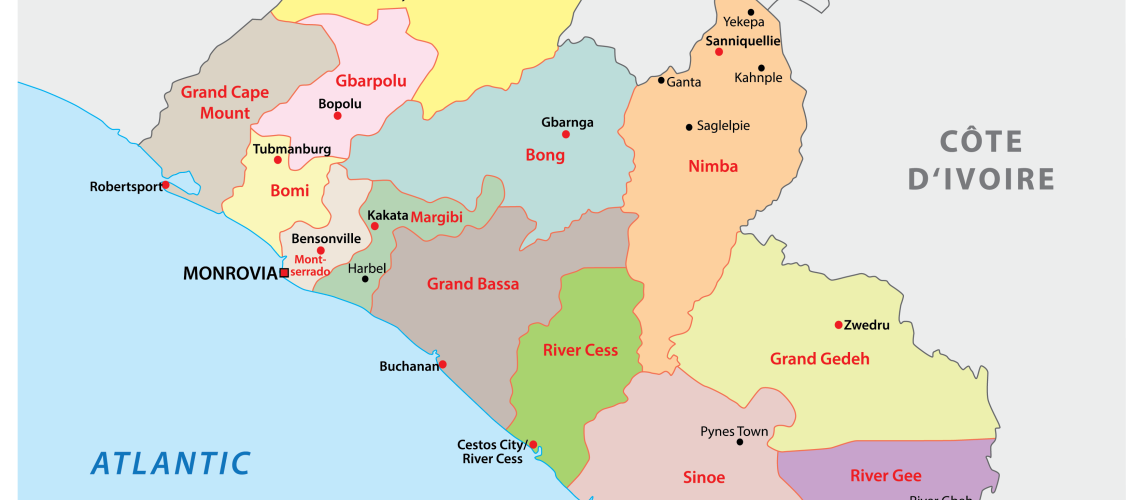
Republic of Liberia – National Overview
The Republic of Liberia is a sovereign nation on the west coast of Africa, bordered by Sierra Leone to the west, the Republic of Guinea to the north, and the Republic of Côte d’Ivoire to the east, with the Atlantic Ocean forming its southern and western maritime boundary. Liberia covers an area of approximately 111,369 square kilometers (43,000 square miles) and is home to an estimated population of 5.3 million people (2022). The capital and largest city is Monrovia. English serves as the official language, while more than 20 indigenous languages reflect the country’s rich ethnic and cultural diversity.
Liberia’s landscape consists of low-lying coastal plains dominated by mangroves and lagoons, rising inland to rolling hills, forested plateaus, and low mountains in the northeast. The country contains about 35 - 40 percent of the remaining Upper Guinean rainforest, which plays a vital ecological role in West Africa’s biodiversity network. The climate is equatorial, characterized by high rainfall and humidity. The rainy season extends from May to October, while the dry season, from November to March, is marked by the northeasterly harmattan winds. Liberia’s major rivers: the St. Paul, St. John, Cestos, Cavalla, and Mano rivers all flow southwest into the Atlantic Ocean, forming important watersheds that support agriculture, fisheries, and hydropower potential.
Historical Context
Liberia holds a unique place in African history as one of the continent’s two countries not formally colonized by a European power. Established by freed African Americans and formerly enslaved people from the United States beginning in the 1820s, Liberia declared its independence on July 26, 1847, becoming Africa’s first modern republic. The new state was founded on democratic ideals and constitutional principles modeled after those of the United States, with governance led largely by the Americo-Liberian settlers.
Over the next century, Liberia contributed to the advancement of Pan-Africanism and African unity. The country was a founding member of the United Nations in 1945 and the Organization of African Unity (now the African Union) in 1963. In 1980, a military coup ended more than a century of Americo-Liberian political dominance, ushering in a period of social and political transformation. The final decades of the 20th century were marked by civil conflict, culminating in two devastating wars (1989–1997 and 1999–2003) that claimed over 250,000 lives and disrupted national development.
Following the 2003 Comprehensive Peace Agreement and democratic elections in 2005, Liberia entered a new era of peace, reconciliation, and reconstruction. The return of democratic governance and international engagement paved the way for stability, institutional reform, and renewed partnerships. In 2006, Liberia made history by electing Africa’s first female head of state, Her Excellency Ellen Johnson Sirleaf. Subsequent peaceful elections and transfers of power have strengthened Liberia’s democratic credentials. The 2023 elections marked another milestone in Liberia’s democratic consolidation, leading to the election of His Excellency Joseph N. Boakai, Sr., as President of the Republic.
Governance and Administration
Liberia is governed as a unitary state with three co-equal branches of government: the Executive, the Legislature, and the Judiciary; all guided by the 1986 Constitution. The country is divided into fifteen counties, each administered by a superintendent appointed by the President. These are further subdivided into districts and clans for local governance. Grand Bassa and Montserrado, established in 1839, are the oldest counties, while Gbarpolu, created in 2001, is the newest. Montserrado County is the smallest by land area but the most densely populated, hosting the capital city and serving as the nation’s principal administrative and commercial center.
Economy and Development
Liberia’s economy is based on natural resources and agriculture, with key exports including iron ore, rubber, gold, timber, and palm oil. Fertile soils and abundant rainfall support smallholder farming, which provides livelihoods for the majority of Liberians. The government continues to pursue policies focused on economic diversification, private sector development, and infrastructure rehabilitation to promote sustainable growth and job creation.
Following the restoration of peace, Liberia has made significant progress in rebuilding institutions and reviving economic activities, aided by international partnerships and investment. Poverty levels remain a major development challenge, but gradual improvements are evident in education, health, and rural infrastructure. The government’s national development frameworks emphasize inclusive growth, youth empowerment, environmental protection, and digital transformation.
Culture and People
Liberia’s cultural landscape reflects a rich mosaic of traditions, languages, and shared history. Sixteen main ethnic groups coexist harmoniously alongside the descendants of the early settlers, collectively contributing to a vibrant national identity. Traditional music, crafts, and dance remain integral to Liberian cultural life, while national holidays such as Independence Day (July 26) celebrate the country’s enduring commitment to freedom and unity.
Environment and Natural Heritage
Liberia’s forests, rivers, and coastal ecosystems remain among its greatest national assets. The government has prioritized environmental conservation, sustainable forestry, and climate resilience as central pillars of national and regional policy. Protected areas such as Sapo National Park and Gola Forest National Park safeguard unique wildlife, including endangered species like the pygmy hippopotamus and the Diana monkey. These natural resources form part of Liberia’s contribution to global biodiversity and environmental sustainability.
Today, Liberia stands as a peaceful and democratic nation, actively engaged in regional cooperation and global partnerships. Guided by its national vision for sustainable development, Liberia continues to build on its rich history of resilience, unity, and progress toward a prosperous future for all its citizens.
